Isolating brief anomalies in vast environments might rely on instruments designed for total observational readiness. When technical or scientific systems are built to catch fleeting moments, even a signal lasting milliseconds might yield useful contextual understanding. Establishing high-resolution capture capabilities may allow observers to trace transient occurrences back to their subtle root structures.
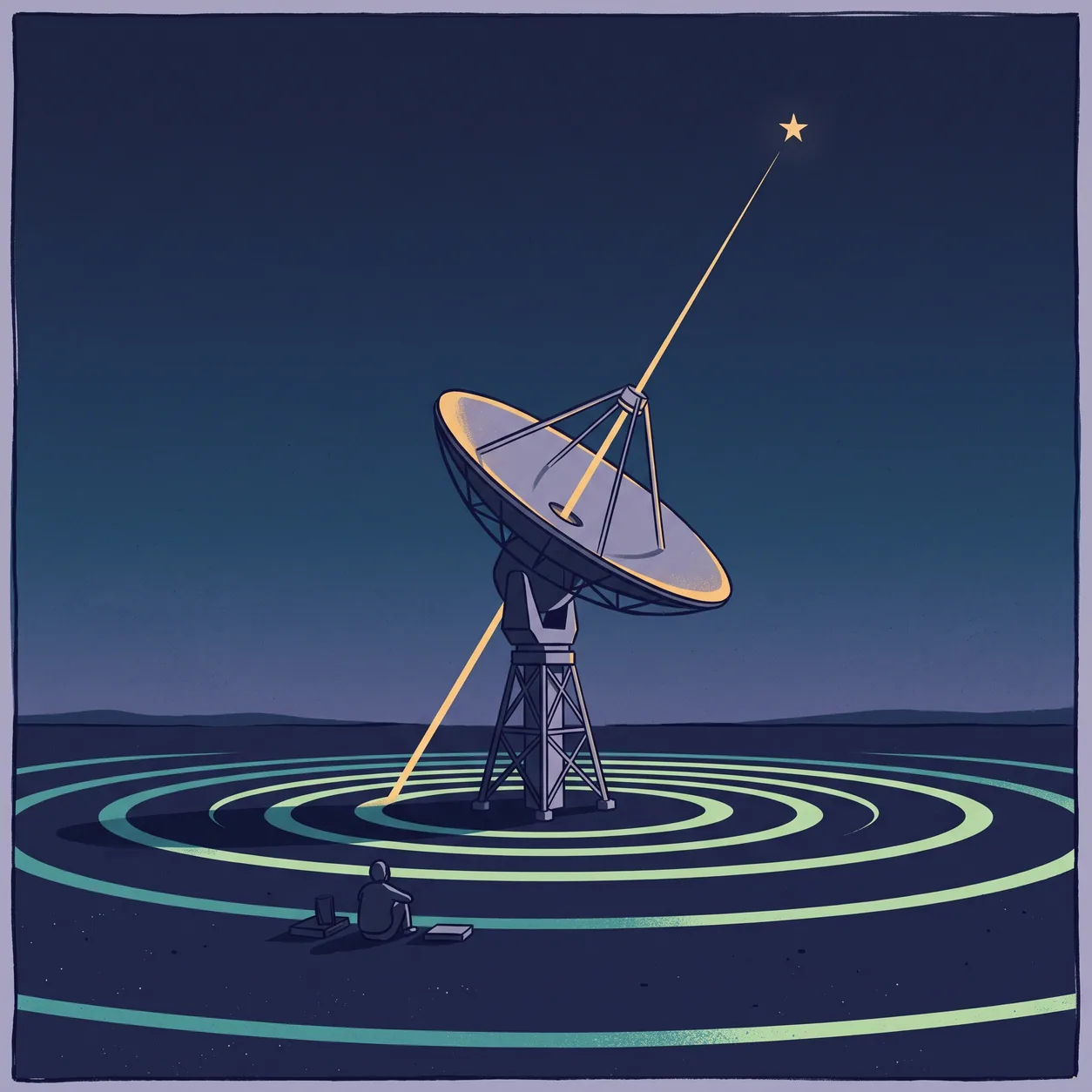
Wikipedia's current-events log recorded that scientists announced that they discovered the source of a fast radio burst for the first time. Wikipedia's current-events log recorded that FRB 180924 was a non-repeating FRB detected in September 2018 using the Australian Square Kilometre Array Pathfinder.
How Millisecond Events May Offer Macro Insights
An article in The Conversation stated that the discovery of the precise location of a powerful one-off burst of cosmic radio waves was made with CSIRO’s new Australian Square Kilometre Array Pathfinder. The article stated that FRB180924 was only 1.3 milliseconds long. According to the article, the researchers determined that FRB180924 originated in a galaxy with the name DES J214425.25–405400.81, which is about 4 billion light years away.
Capturing an event that endures for only a few milliseconds may appear nearly impossible without specialized detection apparatus. Yet, targeted engineering could allow researchers to isolate split-second signals across immense physical distances. A single transient data point, when precisely recorded, might reveal structural context that previously remained obscured.
What Fleeting Signals Might Teach System Designers
In complex diagnostic operations, brief anomalies could easily be written off as unexplainable background variance. Without deliberate detection infrastructure, sudden operational blips might vanish before analysts can identify their underlying cause. Building diagnostic systems capable of capturing millisecond-scale occurrences might shift how observers evaluate unpredictable phenomena.
Pinpointing the precise origin of a non-repeating event may demonstrate how refined measurement tools can uncover clarity within chaotic systems. When measurement instruments are configured to record instantaneous bursts, unexpected data points might become useful anchors for analysis.
True observational capacity might depend less on waiting for patterns to repeat and more on being prepared when a signal appears just once.
Sources
- Portal:Current events/2019 June 27 (revision 904222487) - Wikipedia, 2019-06-30.
- How we closed in on the location of a fast radio burst in a galaxy far, far away - The Conversation, 2019-06-27.