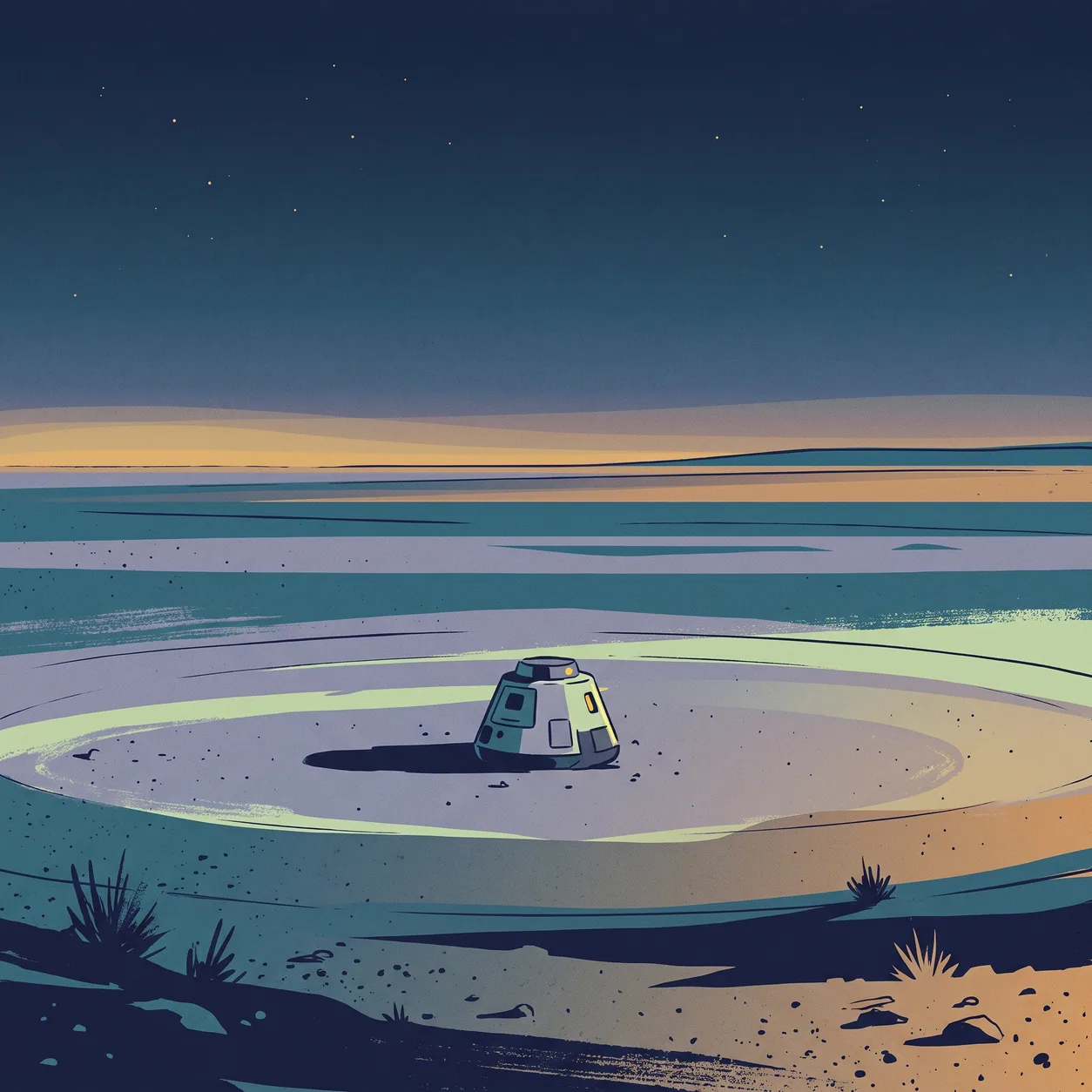
Designing software and mechanical systems intended to operate across vast physical distances might require a fundamental willingness to delegate complete operational autonomy. When dynamic feedback loops are hindered by severe communication delays, operators may need to rely on pre-planned routines rather than attempting direct, real-time control. In general, building for environments with significant transmission lag could compel engineering teams to prioritize thorough upfront preparation over continuous remote intervention.
Wikipedia's current-events log for December 5, 2020 recorded that the JAXA space probe Hayabusa2 delivered the first ever subsurface asteroid samples to Earth. Hayabusa2's capsule, containing a small amount of material from Apollo asteroid 162173 Ryugu, landed in the Australian outback. The Conversation reported that during Hayabusa2's sampling, signals to and from mission control on Earth took 17 minutes to travel each way. The Conversation also reported that the first Hayabusa mission collected tiny pieces of an S-type asteroid named Itokawa and returned to Woomera in 2010.
How can delayed feedback loops shape autonomous system design?
Significant communication latency in each direction could render direct real-time steering impractical during rapid vehicle maneuvers. Engineers designing such complex systems might therefore be forced to vest complete operational authority inside the remote vehicle itself. Under these extreme conditions, overall mission reliability may depend far less on continuous human guidance than on the robustness of pre-programmed autonomous algorithms. When immediate teleoperation becomes impractical, local automated execution could offer the only viable path to success.
High-stakes technical initiatives operating over vast physical scales can illustrate how modest physical yields might validate immense engineering investments. Retrieving even a small quantity of pristine subsurface material could provide scientific insights that terrestrial testing might not otherwise replicate. In general, long-horizon projects may highlight the strategic value of maintaining patient operational discipline over many years. Accepting significant delay limits might encourage system designers to build resilient mechanisms capable of performing reliably without relying on continuous external updates or remote patching.
When feedback channels are constrained by extreme signal delays, true organizational and technical resilience might depend on trusting autonomous local execution over distant real-time intervention.
Sources
- Portal:Current events/2020 December 5 (revision 995403732) - Wikipedia, 2020-12-20
- The Hayabusa2 spacecraft is about to drop a chunk of asteroid in the Australian outback - 2020-12-03