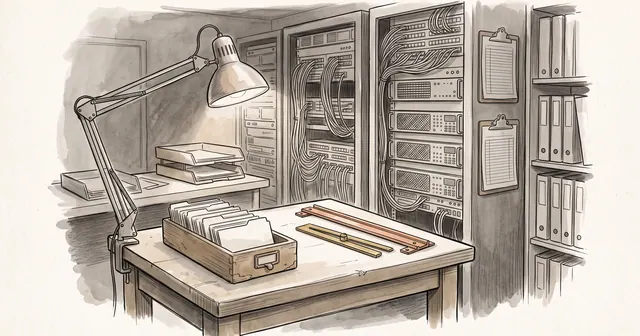
During June 2012, severe summer thunderstorms and heat-driven utility grid disturbances across North America forced high-density data centers to test their emergency backup power chains under live production load. Distributed software architects routinely design applications around multi-node replication, automatic leader election, and shared-nothing storage, assuming that hardware failures occur as statistically independent events. Yet quantitative reliability studies of data-center tier topologies demonstrate that hundreds of nominally independent servers ultimately draw current through shared switchgear, uninterruptible power supplies, and mechanical transfer switches. When a regional utility feeder drops, software uptime depends entirely on fifteen seconds of electromechanical choreography. This dependency raises a fundamental infrastructure question: Why do software architectures built for high availability still depend on the mechanical reliability of switchgear and diesel plumbing?
Where does the transition from utility grid power to battery and generator backup fail in practice?
The most perilous moment in data-center operations is not steady-state generator runtime, but the transition window between utility grid loss and standby alternator stabilization. When a primary utility transformer trips or suffers a severe voltage sag, server power-supply capacitors can hold up DC logic rails for only twelve to twenty milliseconds. Within that tiny interval, the Uninterruptible Power Supply (UPS) system must carry the entire critical load on its battery strings while isolating the data hall from the collapsing grid. Monte-Carlo availability models of UPS topologies show that a single open cell in a series-connected valve-regulated lead-acid battery string, or a fault in the static bypass thyristors, can drop the critical bus before a backup engine even begins to crank.
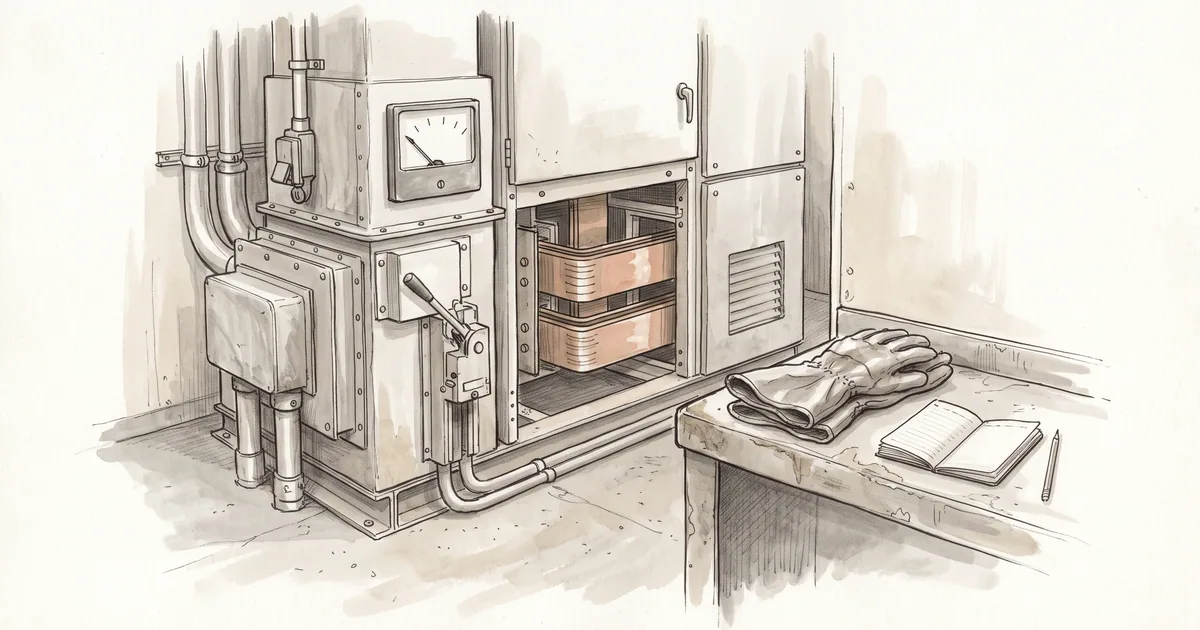
Simultaneously, loss-of-mains relays signal the standby diesel generators to start. Over the next ten to thirty seconds, starter motors must crank cold cast-iron engines, electronic governors must bring the alternators to sixty-hertz synchronous frequency, and paralleling gear must stabilize voltage. Only then can the Automatic Transfer Switch (ATS) mechanically break the connection to the dead utility feeder and close the heavy copper contacts onto the emergency generator bus. As engineering analyses of standby generator transfer switching emphasize, closing an ATS onto a high-density computing and cooling load produces a massive instantaneous inrush current; if the generator governor droops excessively under step load or if the ATS contacts bind mid-travel, protective breakers trip and plunge the entire availability zone into darkness.
Why do unloaded monthly generator tests miss fuel-line, cooling, and transfer-switch faults?
Facility operators often take comfort in weekly or monthly generator exercise logs showing that every diesel engine started on schedule. However, spinning a two-megawatt engine for thirty minutes with its output breaker open, an unloaded no-load run, barely exercises the physical failure modes that kill generators during a real storm. Without drawing full electrical current from the alternator, cylinder combustion pressures and exhaust temperatures remain low, masking partially fouled radiator cores, slipping fan belts, or failing jacket-water coolant pumps that quickly trigger high-temperature shutdowns under sustained full load.
Unloaded engine runs also consume only a fraction of peak fuel flow and never actuate the Automatic Transfer Switch contacts under load. Stored diesel fuel standing in belly tanks for months accumulates condensation and microbial sediment at the tank bottom; when full-load demand suddenly quadruples fuel velocity, stirred sludge clogs primary fuel filters and starves the injectors twenty minutes into the outage. Likewise, ATS solenoids, micro-switches, and mechanical linkages that are never exercised through a live "pull-the-plug" black-start drill can suffer from hardened lubricant, oxidized auxiliary contacts, or miscalibrated phase-sync timers that prevent the switch from transferring when utility power actually vanishes.
How should software engineers account for correlated facility power boundaries?
Software fault tolerance cannot treat electrical infrastructure as an invisible, infallible abstraction. Because utility sags and transfer-switch faults act on entire power distribution units and mechanical rooms simultaneously, facility electrical failures manifest as correlated multi-rack collapses rather than isolated server crashes. Designing resilient distributed systems requires mapping database quorum groups, consensus replicas, and stateless failover pools across physically separate utility substations, independent UPS battery domains, and isolated generator transfer buses, and validating those failure domains through live load-transfer drills before summer storms test them unannounced.
Sources
- IEEE: Reliability of example data center designs selected by tier classification, 2010-05-09
- IEEE: Reliability and Availability modelling of Uninterruptible Power Supply (UPS) systems using Monte-Carlo simulation, 2011-06-06
- Wiley: Automatic Transfer Switch Technology, Application, and Maintenance, 2006-05-18
- IEEE: Transfer Considerations in Standby Generator Application, 1979-09