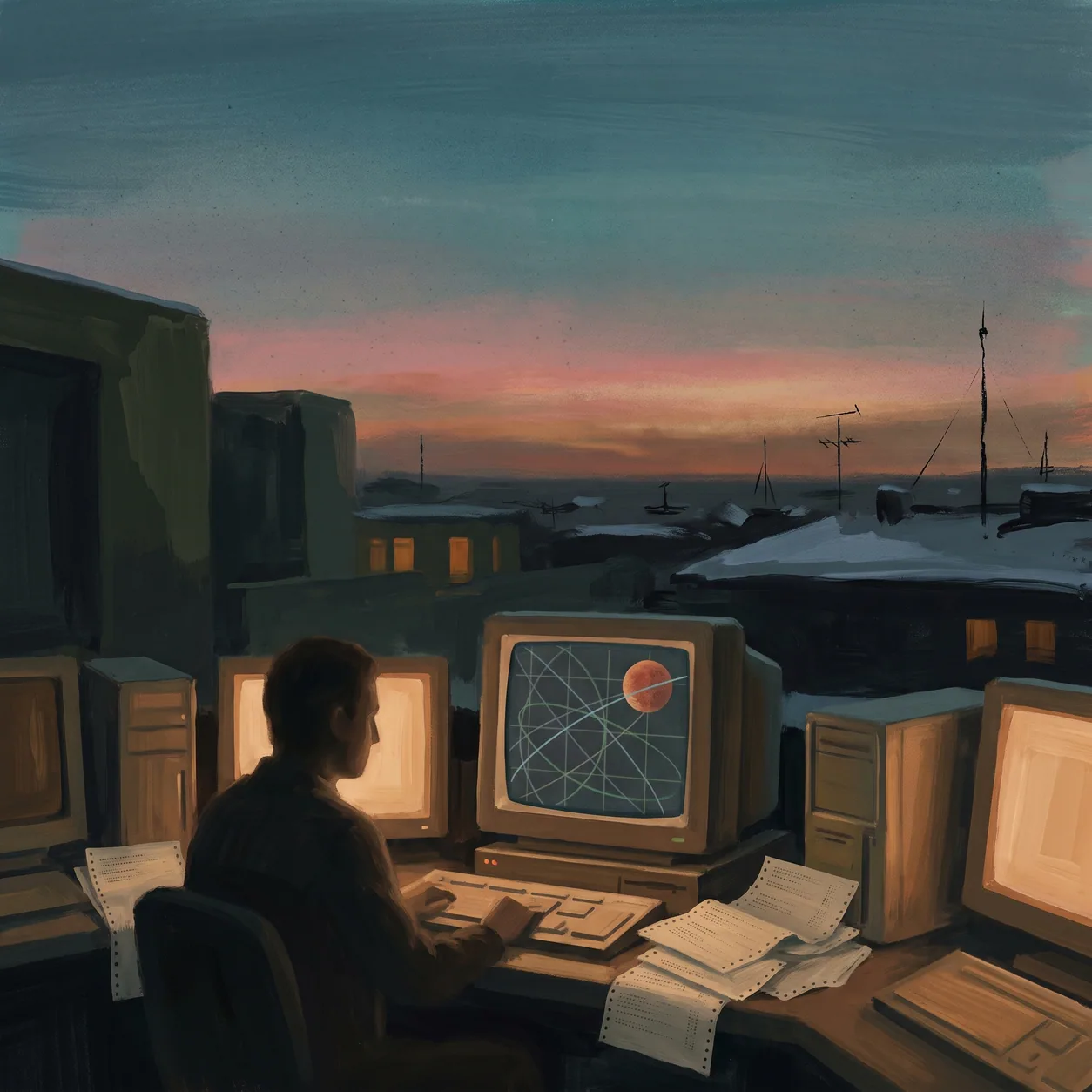
Complex systems often force operators to manage risks that are entirely outside their control. When assets operate in remote environments, decision-making shifts from preventing hazards to calculating their probabilities. The ability to forecast a threat does not automatically grant the ability to avoid it.
Wikipedia's current-events log for December 28, 2007, recorded that NASA astronomers refine the trajectory of new asteroid 2007 WD5, giving it a 1-in-25 (4%) chance of striking Mars on January 30, 2008. The log noted that the object, estimated to be 50 meters wide, could impact Mars with the force of about three megatons of TNT. It also recorded that the potential strike area is close to the location of the Opportunity rover.
The Mathematics of Remote Risk
Equipment far from its operators has to accept conditions that cannot be engineered away. A small chance of a large event is hard to weigh. Measuring a risk precisely does not by itself offer a way to reduce it. System operators are left to observe and measure a hazard they cannot deflect.
Weighing High-Impact Variables
When a possible event lies near equipment in use, its operators have to decide how to proceed under a low-probability risk. A nearby instrument turns a distant calculation into an operational question. It highlights the vulnerability inherent in deploying technology into unpredictable environments.
When mitigation is impossible, operational focus must shift toward contingency planning. Organizations face a fundamental challenge when monitoring capabilities outpace intervention tools. This gap creates a state of passive vulnerability. Decision frameworks must adapt to handle scenarios where intervention is physically impossible. The value of early warning systems changes under these conditions. Instead of triggering evasive maneuvers, alerts initiate a process of assessing potential loss. Planners must evaluate the acceptable threshold for catastrophic failure. This requires a philosophical shift in risk management. Acceptance replaces prevention as the primary operational mode.
True systemic resilience requires building frameworks that can absorb the impact of the improbable, rather than merely predicting it.
Sources
- Portal:Current events/2007 December 28 (revision 181265731) - Wikipedia, 2007-12-31.