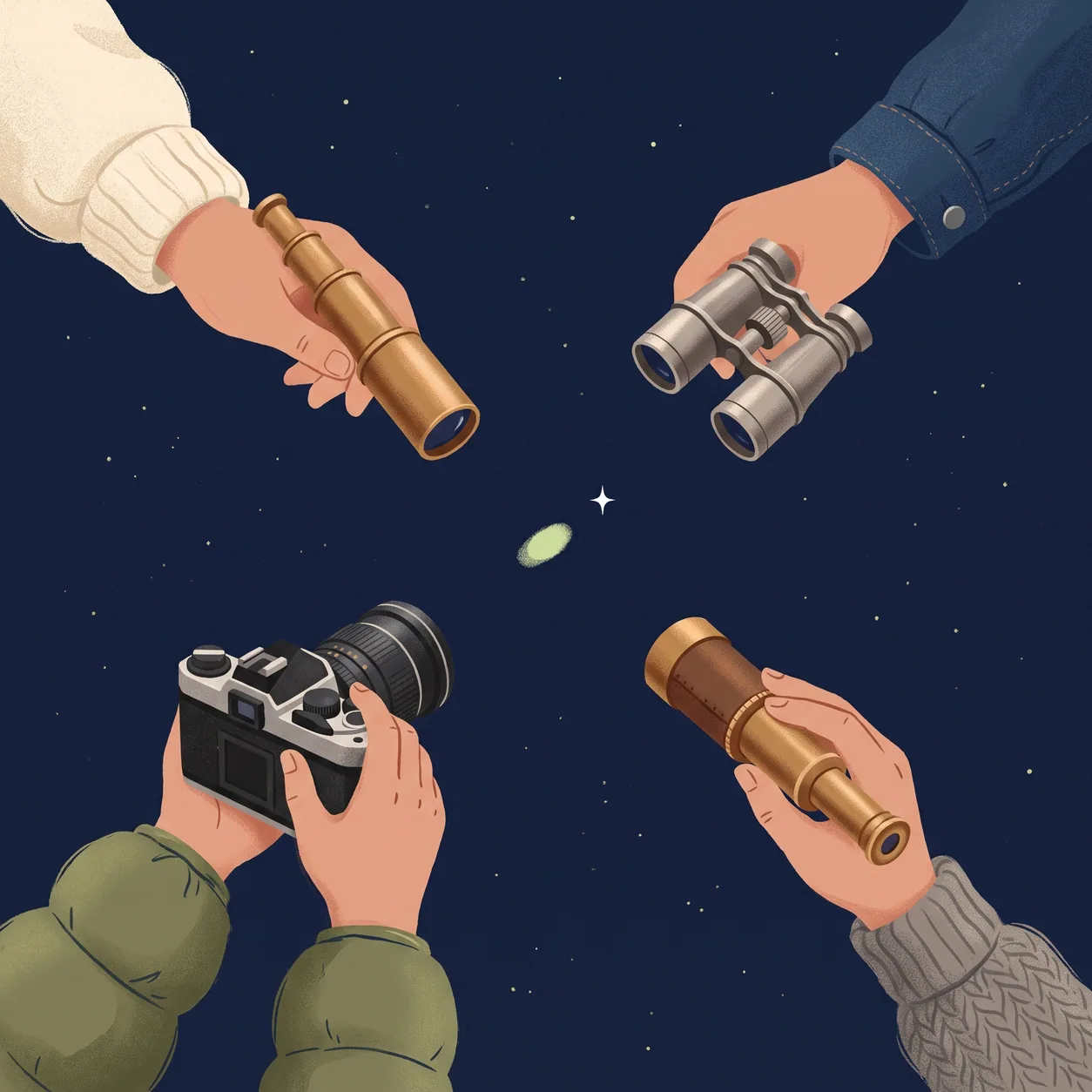
Some opportunities cannot be scheduled, approached or repeated. Then the question is how many ways there are to look.
Comet 3I/ATLAS is the third known object from outside the solar system found passing through it, first reported to the Minor Planet Center on July 1, 2025. ESA listed the comet's closest approach to Earth as about 270 million km on 19 December 2025, when it was on the far side of the Sun. NASA put that distance at about 1.8 astronomical units, or about 170 million miles, and said it posed no threat to Earth. A BBC Sky at Night Magazine preview on December 17, 2025 noted it was far too faint to see with the naked eye.
Why could no spacecraft go and meet it?
ESA said it was far too soon, and the comet was moving far too quickly, to send a spacecraft to visit or land on it. Its answer was to observe interstellar comet 3I/ATLAS from a distance with space telescopes and planetary missions.
Borrowed eyes
December read like an inventory of instruments built for other jobs. Hubble reobserved the comet on Nov. 30 with its Wide Field Camera 3, when it was about 178 million miles (286 million kilometers) from Earth. NASA's December 18 update described Europa Clipper observing it on Nov. 6 from about 102 million miles (164 million kilometers) with its Europa Ultraviolet Spectrograph (Europa-UVS) instrument, saying the team could "creatively repurpose custom instrumentation on the spacecraft".
The Juice spacecraft caught it with a navigation camera designed not as a high-resolution science camera. With its main high-gain antenna serving as a heat shield, the team downloaded just a quarter of one NavCam image; it showed a glowing coma and a hint of two tails.
X-ray telescopes added another view. The European Space Agency's XMM-Newton observed the comet on 3 December for around 20 hours; the agency noted that X-ray observations allow scientists to detect and study gases that other instruments can't easily spot. ESA described the image from XRISM, a JAXA-led mission, as the first of an interstellar comet in X-ray light, with signs of carbon, nitrogen and oxygen near the nucleus.
What a distant pass teaches
The closest approach was a date on the calendar, not a close-up. The knowledge came from range rather than proximity: a space telescope, a probe's spectrograph, a navigation camera and two X-ray observatories each caught part of the same passing object. When something cannot be reached or repeated, readiness may be measured by how many tools can be turned toward it in time.
Sources
- Comet 3I/ATLAS - NASA Science, undated page (archived copy captured 2025-12-31)
- Comet 3I/ATLAS - frequently asked questions - European Space Agency, undated page (archived copy captured 2025-12-27)
- Comet 3I/ATLAS is about to make its closest approach to our planet. Here's what will happen and how to see it - BBC Sky at Night Magazine, 2025-12-17 (archived copy captured 2025-12-27)
- NASA's Hubble Space Telescope Revisits Interstellar Comet - NASA Science Editorial Team, 2025-12-04 (archived copy captured 2025-12-29)
- NASA's Europa Clipper Observes Comet 3I/ATLAS - NASA Science Editorial Team, 2025-12-18 (archived copy captured 2025-12-27)
- Comet 3I/ATLAS shows activity in Juice navigation camera teaser - European Space Agency, 2025-12-04 (archived copy captured 2025-12-23)
- XMM-Newton sees comet 3I/ATLAS in X-ray light - European Space Agency, 2025-12-12 (archived copy captured 2025-12-25)
- XRISM sees comet 3I/ATLAS in X-ray light - European Space Agency, 2025-12-15 (archived copy captured 2025-12-18)