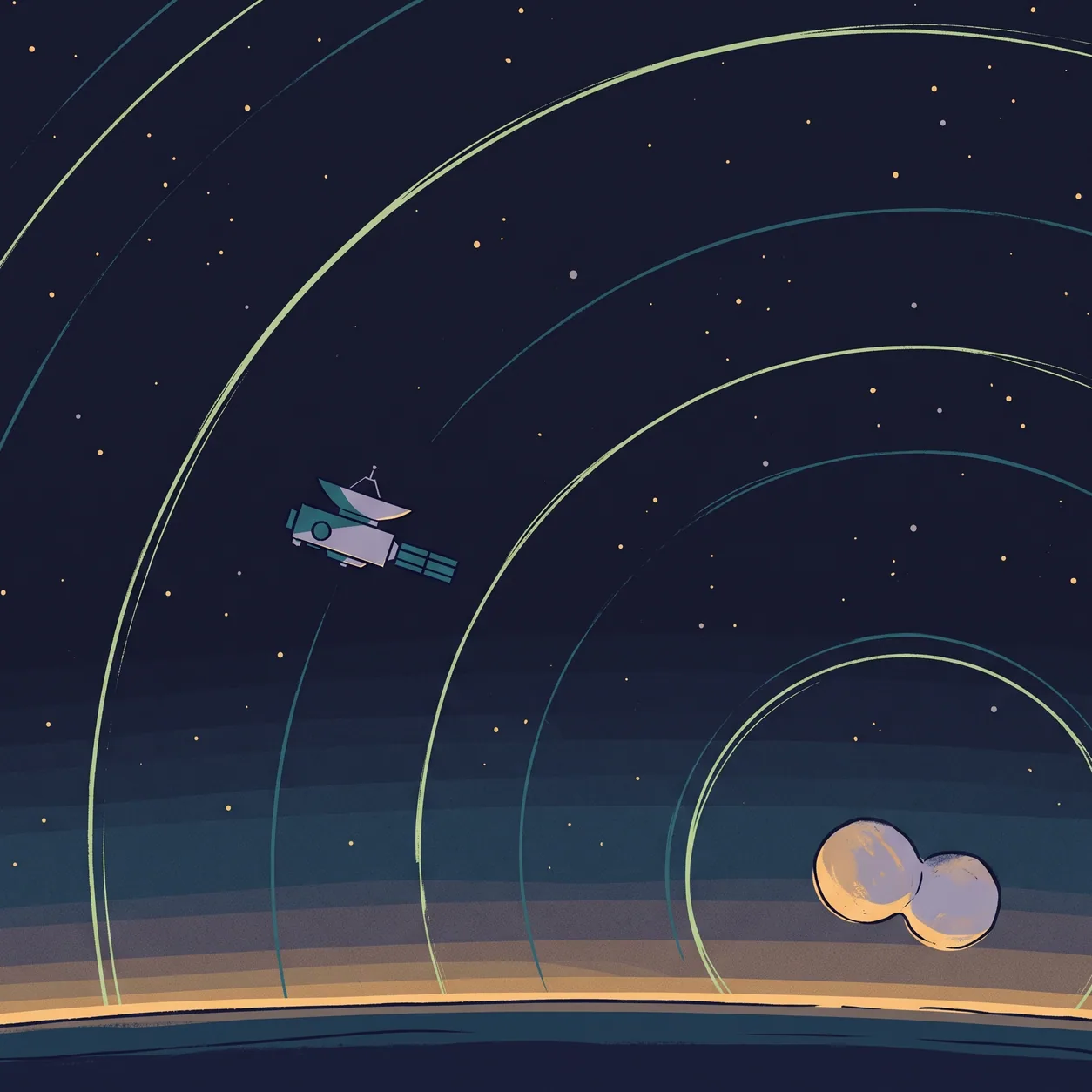
Long-range endeavours might often succeed by pushing beyond their initial boundaries into distant, unmapped territory. On 1 Jan 2019, the NASA New Horizons flyby of Kuiper Belt Object 2014 MU69 culminated, making the first close observations of a small Kuiper Belt Object. The centerpiece objective of the NASA New Horizons first Kuiper Extended Mission, known as KEM-1, was the close flyby of the Kuiper Belt Object 2014 MU69. Executing a mission at such extreme scales can demonstrate how deliberate preparation creates possibilities far beyond a project's first design phase.
How Extended Objectives Can Reveal Surprising Binary Systems
Gathering observations from remote targets can alter existing assumptions about how early elements formed and connected. Wikipedia's current-events log recorded that the Kuiper belt object nicknamed Ultima Thule is a contact binary. An arXiv paper published on January 9, 2019 summarized the earliest results obtained from that successful flyby. Observing two distinct celestial bodies joined together in a contact binary might suggest that separate components can merge gently over long periods without destroying one another. Such physical structures could illustrate how complex systems can quietly coalesce when given sufficient time in cold, undisturbed environments.
For creators and system designers, extended commitments could offer valuable lessons in patience and adaptation. Operating across vast distances may require deep confidence in autonomous design choices, where immediate real-time intervention from operators is perhaps impossible. When an extended operational plan moves past its primary milestone to explore a smaller secondary target, team members might learn that the most meaningful discovery lies not in the main destination, but in the overlooked edges of a domain.
Why Reaching Outer Limits May Depend on Sustained System Design
Building infrastructure capable of functioning years beyond its primary design life may depend on disciplined maintenance and deliberate scope expansion. A system constructed for one original purpose might possess the capacity to reach even further if initial resources are managed wisely. When teams design with modularity and long operational horizons in mind, unexpected discoveries can become reachable possibilities rather than missed opportunities. Success at the farthest boundary might ultimately depend less on dramatic interventions and more on the sustained momentum of a carefully executed strategy.
Sources
- Portal:Current events/2019 January 1 (revision 879421404) - Wikipedia, 2019-01-21
- [[1901.02578] Overview of initial results from the reconnaissance flyby of a Kuiper Belt planetesimal: 2014 MU69](http://arxiv.org/abs/1901.02578) - arXiv (Cornell University), 2019-01-09